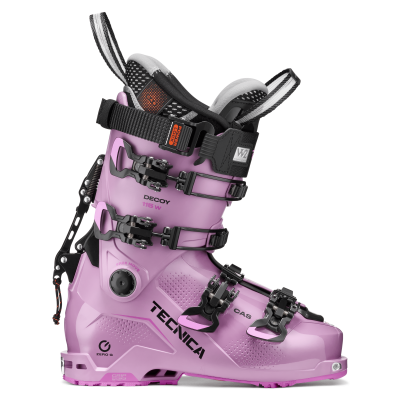
While our women’s test team was indeed lured-in by the new Tecnica Zero G Decoy 115 W (specifically by its luscious Progressive Pink cosmetic), what they found when they got their feet into it and onto snow was that this was no stand-in but rather the real deal. They said that for skiers who have still been seeking a boot with legit, backcountry touring skills that doesn’t compromise on real skiing power, the search is over.
Sure, you’ve heard this claim before but the freeride boot space continues to expand and improve and luckily for us the one-boot-that-does-it-all is as close to reality as it’s ever been. The difference now, is that where most alpine brands have previously hike-ified solid downhill boots (i.e. the Cochise was born of Mach1 DNA), the new Decoy is a descent-erated backcountry boot. Tecnica took the Zero G, which was already a hell of a good-skiing BC boot and put it on an all-protein diet in the form of a polyurethane shell and cuff—you know, real boot plastic.
This made perfect sense to our test team, who have had previous experience with both ends of Tecnica’s freeride-BC spectrum. They’ve loved the alpine mannerisms of the Cochise boots but always found the cuff’s range-of-motion and quality of movement a bit lacking in touring mode. On the other hand, while the Zero G Tour Pro W has crushed the others in the backcountry group with its skiing strength, it didn’t have the torque and stability of the Cochise. Taking the nearly flawless blend of up and down found in the Zero G line and giving it a bit more power for managing bigger, wider skis in demanding terrain was a good call, testers agreed, saying that it was the ideal hybrid of the two genetic donors.
Yes, there’s some added weight associated with muscling-up, but it’s not much—the Decoy shell is 330 grams heavier than the women’s top Zero G (the weight of one 12 oz can of PBR) and the Decoy liner is about 100 grams heavier (the weight of a bar of soap). While it might be difficult to put one less can of PBR in the day pack, consider that backcountry skiers don’t even use soap, so we think these are pretty acceptable trades for higher descent performance.
Speaking of the Decoy’s in-betweener liner, testers appreciated the additional structure and padding in comparison to the thin and ready to pack-out stock liner of the Zero G—it held them in place for the run down but they really liked the secure-but-padded lock on their heels during the ascent, avoiding excessive movement (and blisters).
The Decoy’s underfoot connection with the ski is exceptional, testers concurred, saying that they could feel texture changes in the snow through the boot’s thin but rigid sole. They did not all love the underfoot low ramp angle of the Decoy, and a few testers commented that adding a quarter-inch of heel lift improved the fore-aft balance of the set-up substantially for them.